I recently heard an interview with Holly Brockwell, a 30-year-old woman who campaigned for four years to undergo a sterilisation procedure on the NHS. At the age of 26, Holly made the decision to approach her GP about the procedure because she knew that she did not want to have children. The doctors she visited told her that she was “far too young to take such a drastic decision”, instead suggesting that her boyfriend, 2 years her junior, undergo a sterilisation procedure (vasectomy) instead.
Sterilisation is a permanent form of birth control
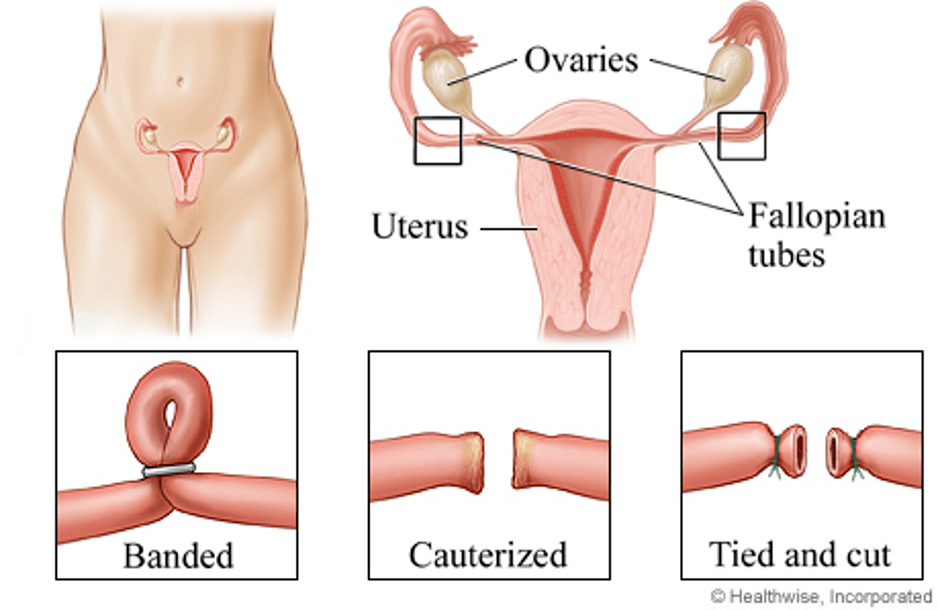
Sterilisation acts to prevent the passage of either sperm or the ovum (egg) through the fallopian tubes, thereby preventing fertilisation of the egg and pregnancy. Whilst the procedure in both men and women can be reversed, the success rate for reversal of female sterilisation is lower than in males, reported at only around 25-50%, and is not currently available on the NHS. Estimated costs to have the procedure done privately range from £4500 to £5500). Some women suffering Post-Tubal Ligation Syndrome (PTLS), a debilitating condition characterised by symptoms including abdominal and back pain, have been successful in having the procedure reversed on the NHS, however PTLS is not recognized by all doctors as a medical condition.
Tubal Ligation (a.k.a. ‘getting your tubes tied’)
The process of sterilisation in women requires the blockage or ligation (tying off) of the fallopian tubes, the structures that carry the ovum from the ovaries to the uterus for fertilisation. Procedures may involve excision of all or part of the fallopian tube, the use of clips or rings to ‘tie’ the fallopian tubes, or electrocauterisation in which an electrically-heated instrument is used to burn the tissue of the fallopian tube, causing it to close off.
What about menstruation?
Release of the ovum (egg) from the ovaries, and the preparation of the uterine lining for implantation of a fertilised ovum, are two cyclic events which must line up in order for the individual to be fertile. Whilst hormonal contraceptives such as the pill prevent release of an ovum (egg) from the ovary in order to prevent pregnancy, female sterilisation does not prevent release of the ovum from the ovary, but simply prevents it from reaching its target destination: the uterus. Unlike the application of contraceptives containing hormones which may also serve to influence the uterine cycle (leading to alterations in periods such as producing a lighter or more infrequent flow, or in some cases heavier and more irregular), female sterilisation does not affect the uterine cycle, and so period flow, intensity, and regularity should not be affected.
What happens to the ova?
Sterilisation procedures only prevent the passage of the ova (or the release of sperm in ejaculate in males) – but these gametes (reproductive cells) are still present, so where do they go? In both males and females, the body will absorb any unused sperm or unfertilised ova – a process which routinely happens during the body’s normal processes. In fact, when you have your period the unfertilised egg has already disintegrated; the main function of menstrual fluid is actually the removal of the uterine lining from the body rather, than a mechanism to remove the unfertilised egg.
A woman’s right. A life-changing decision(?)
Every woman, every individual, should have the right to decide what happens to their own body. For making the decision to seek sterilisation, and despite the fact that this decision affects no-one but Holly herself and her partner, Holly received a tirade of online abuse;
“I’ve been patronised, ignored, harassed, judged and demonised, but I’ve never wavered in my determination to be sterilised”.
 Holly Brockwell (Twitter)
Every woman should hold the right to decide whether she wants to have children, and whether to seek sterilisation. Whilst sterilisation does not stop menstruation and cannot protect against STDs (sexually-transmitted diseases), the procedure is an effective contraception for preventing unwanted pregnancy. In addition, female sterilisation is associated with a 50% reduction in life-time risk of ovarian cancer, however the mechanism of this correlation is currently unknown.
Low success rates of reversal procedures means that female sterilisation is often viewed as a choice from which there is no return, however with advances in assisted reproductive technology, such as in-vitro fertilisation (IVF), and thousands of children currently awaiting adoption, there is no barrier to sterilised individuals one day having children if they desire.
The fact that one woman seeking sterilisation caused such a media storm is a sad reflection on our times when a woman’s ownership over her own body is questioned. Individuals like Holly Brockwell who speak up for their right to be the decision-makers over their own bodies will hopefully lead to a breakdown of the societal taboos surrounding issues such as female sterilisation.
A personal note.
Personally, I am unsure of my future regarding children. I am in my late twenties and I presently have little desire to have children. I cannot say for certain however that my view on this won’t change in the next 10 or so years. I occasionally daydream about having a little mind to develop and teach about the world, but I would only want this to happen if and when I own a house (laugh!), have developed my career (laugh? – please someone hire me!), and am financially secure (longest and loudest laugh saved for last).
– Jess
Last updated April 2020


 Science, She Wrote
Leave a reply to Teabag Cancel reply