Ever wondered why almost every medicine or drug available over-the-counter or on prescription comes with the somewhat vague warning: ‘Pregnancy and breastfeeding: Ask your doctor or pharmacist for advice before taking any medicines’? The answer is simply that for many years it has been considered unethical to test drugs on pregnant women, and so many new pharmaceuticals are not tested on pregnant women before being marketed.
Despite this, at least 40% of women are thought to require prescription drugs at some point during pregnancy, and so these expectant mothers are faced with a choice: risk taking the drug without knowing the effects it may have on the developing foetus, or stop taking the drug and suffer the (potentially debilitating) health consequences. If ever the phrase ‘between a rock and a hard place’ was applicable, this is it.
The Thalidomide Scandal
Fears about testing new drugs on pregnant women are easy to understand, especially when considering incidents such as the Thalidomide disaster in Britain during the 1960s. In post-World War II Britain, pregnant women began taking a newly marketed anti-emetic drug to prevent morning sickness, but soon found themselves giving birth to children with severe and debilitating malformations as a direct result of the drug’s toxicity on the developing embryo. Over 10,000 children are thought to have been affected, however the actual number is thought to be significantly higher.
I recently watched the documentary ‘Attacking the Devil’ (2014) on Netflix which takes a close look at the scandal; it opens with Martin Johnson (The Thalidomide Trust) who explains how the Thalidomide disaster exceeds the sinking of the Titanic, the nuclear accident at Chernobyl, and the industrial disaster in Bhopal, India “ten times over and more”. With a start like that, you know that this documentary isn’t going to pull it’s punches.
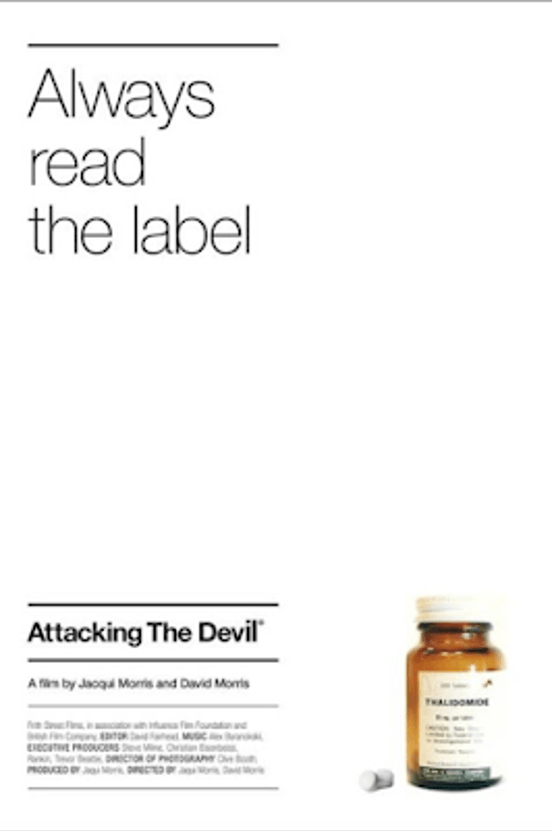 Marketing for ‘Attacking the Devil’ documentary (2014)
Whilst the documentary is very light on science, it provides a startling look at the events leading up to the Thalidomide scandal, including the shocking revelation that the drug was tested on concentration camp prisoners during World War II, and the aftermath in which The Sunday Times campaigned to claim adequate compensation for the victims of Thalidomide and bring the controversy to light.
A Devil in Disguise
Thalidomide was originally administered as a sedative to treat morning sickness (which at the time was thought to occur psychosomatically; that is pregnant women would become so overexcited about being pregnant that it would make them nauseous!), although its origins date back to the Nazi chemical warfare program as a nerve agent antidote.
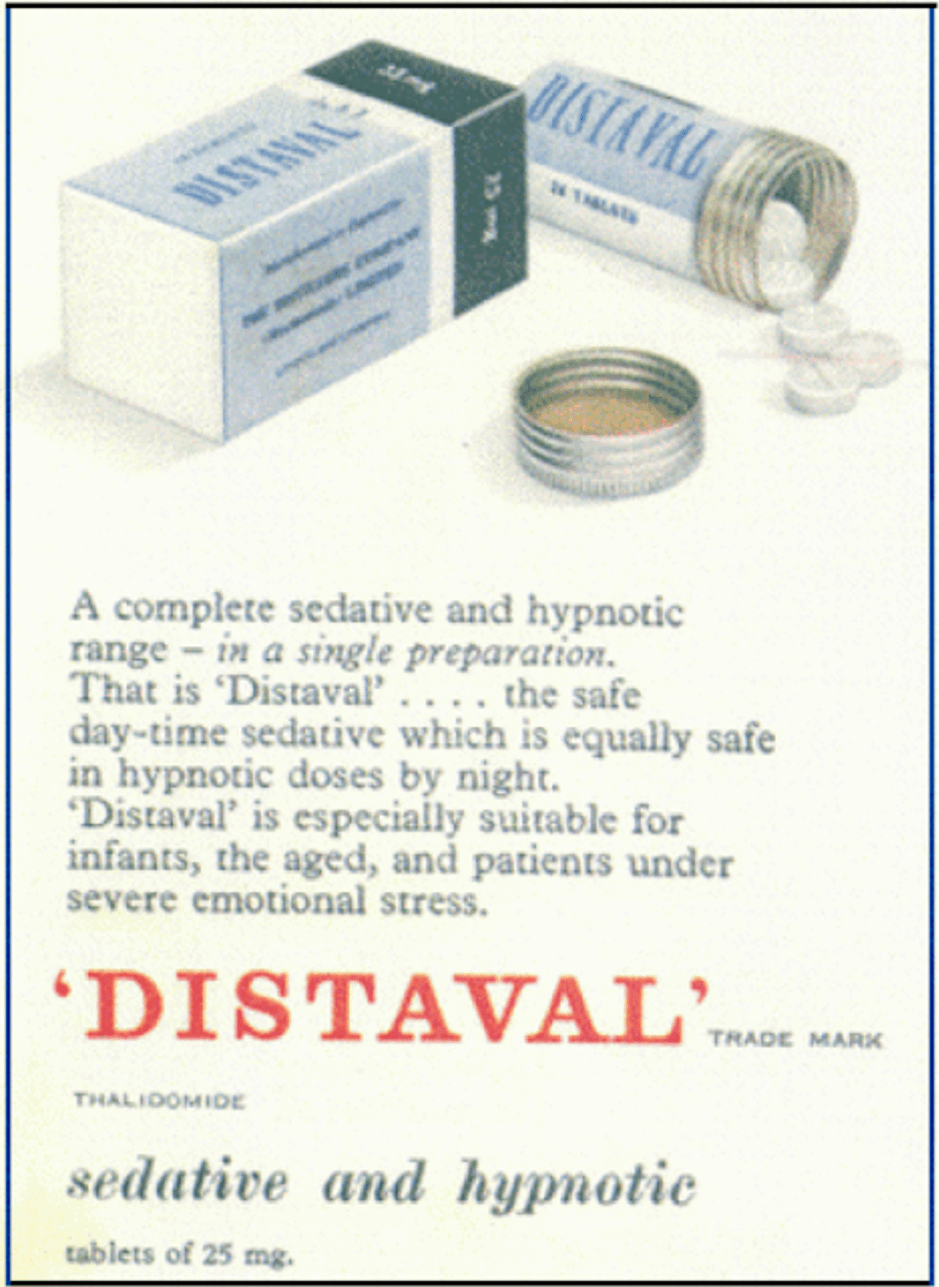 Advertisement for Distal (Thalidomide), circa 1961.
Infants born to mothers who took Thalidomide, under its marketed name of ‘Distaval’, suffered phocomelia (a malformation of the limbs) in addition to eye, inner and outer ear, heart, and digestive and urinary tract effects. Which organs/structures were affected appeared to depend upon the period of exposure, for example exposure to the drug 24-33 days post-conception resulted in malformation of the arms.
Thalidomide was tested to the standards of the time when no-one thought drugs could cross the placenta; clinical trials on rats did not show malformations comparable to those seen in humans and so the drug was marketed as being completely safe. Subsequently, new regulations were introduced which specified that drug trails must be conducted in at least two species, a measure that has meant that over the past 40 years of clinical drug trials there have been no deaths and only one serious incident, but some are beginning to question whether this ‘two species’ approach needs to be the case for all drugs.
Should pregnant women be included in drug trials?
Understandably, the Thalidomide disaster made many nervous about testing new drugs on pregnant women, and so this group are often excluded from drug trials, however many see the Thalidomide disaster as a justification for adequate testing on pregnant women. Current guidelines by the UK Government’s ‘Blue Guide’ state that ‘all drugs should be avoided if possible during the first trimester’ and ‘no drug is safe beyond all doubt in early pregnancy’, therefore the main available means by which information can be gathered on drug safety during pregnancy are by pregnancy exposure registries; instead of properly controlled clinical trials, women who are already taking drugs when conceiving or pregnant can enrol in these registries which collect health information on the mother and infant to help expand knowledge and improve drug labelling.
The need to re-address official guidelines involving controlled drug testing in pregnancy are highlighted by the Zika virus epidemic in the Americas and Pacific. The virus can be passed from an infected mother to foetus, causing microcephaly (small heads) and severe brain malformations, but in order to develop an effective vaccine researchers need to be able to include pregnant women in clinical trials, however there are many considerations on the best way to do this ethically.
To end on a more positive note, it is quite often the case in drug discovery and research that whilst a drug may have undesirable effects for its original intended use, it may find use elsewhere; there is the classic example of Viagra, which was designed as a blood pressure medication, but had an unintended (and highly profitable) side effect in treating erectile dysfunction. Thalidomide, whilst no longer in use to treat morning sickness in pregnant women, is used to treat multiple myeloma, and has been investigated for use in treating leprosy (although the World Health Organisation does not approve its use here) and Human-Immunodeficiency Virus (HIV).
-Jess [Last updated: May 2020]
Read more about the Thalidomide story: Kim, J.J. and Scialli, A.R. (2011) Thalidomide: The Tragedy of Birth Defects and the Effective Treatment of Disease, Toxilogical Sciences, Vol. 122, No. 1. pg. 1-6

 Science, She Wrote
Leave a comment