If have ever tried growing your own veg. or cultivating a garden, you will know of the blight of slugs. Typically descending after a downpour, slugs can come out in force and destroy all your hard work in a very short time span.
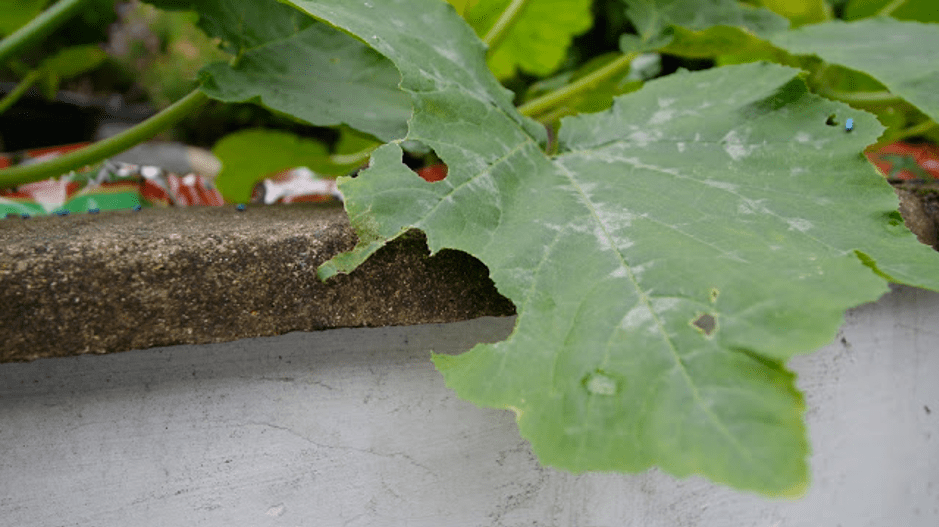 Evidence of midnight snacking on our courgette plant leaves!
I recently moved house and unfortunately had to dispose of my tomato, courgette, and French bean plants that I had been growing (frustratingly before the tomatoes had sufficient chance to ripen). Whilst I had them, I found a strange sense of satisfaction in eating home-grown food. An aspect of the home grower act that didn’t sit well with me, however, was the routine sprinkling of little blue chemical pellets around the growing plants in order to kill slugs tempted for a tasty snack.
The active ingredient found in slug pellets is typically Metaldehyde or Methiocarb, though a quick look in your local garden centre will most often reveal Metaldehyde as the more popular choice. Metaldehyde is a pesticide that acts against slugs and other gastropods, damaging mucus cells and causing the slug to exude massive amounts of slime, with death brought about by severe dehydration. This toxin can even work on contact and does not require ingestion by the slug. Methiocarb, the more toxic of the two compounds, must be ingested and has almost the opposite effect causing death by stimulating the slug to swell up with fluid.
Whilst growing the various crops, I used slug pellets that my neighbour already had from previous years of vegetable growing. These pellets contained Metaldehyde as the active ingredient and certainly performed the job they were supposed to, as evidenced by the numerous piles of phlegm-looking material I would frequently find around our garden:
 A very effective (if very messy) form of pest control; I would often find numerous piles of slime around the garden in the morning.
Unfortunately, despite proving effective, slug pellets such as these come with inherent risks. Metaldehyde pellets may not only attract slugs, but household pets and other animals, and may prove fatal if consumed. Metaldehyde toxicosis is a serious issue for dogs, with a lethal dose of only 100mg/kg. Cats are also at risk, although the degree of toxicity does not appear to be as severe, with a lethal does of 207mg/kg. Even so, much lower doses can still result in severe clinical effects. Metaldehyde can cross the blood-brain barrier and interfere with neurotransmitters resulting in central nervous system (CNS) stimulation and muscle tremors which may lead to hyperthermia (an elevated body temperature) and cellular necrosis (cell death) within minutes. Victims of metaldehyde poisoning also suffer severe metabolic acidosis (reduced blood and tissue pH), which can progress to decreased rate of breathing and heart rate, leading to loss of consciousness possibly coma or death. Animals suspected of suffering metaldehyde toxicosis need immediate treatment; for dogs death can occur in around 4-24 hours post-exposure, and even if they survive may develop liver failure within 2-3 days. Unfortunately, there is no antidote. Emesis (vomiting) induced with half an hour and other procedures to try and remove the poison from the system and prevent absorption are the most successful approaches.
Animals are not the only ones at risk. Metaldehyde poisoning may also occur in children if left unsupervised in a garden containing slug pellets. Additionally, news reports in 2013 reported, rather alarmingly, that the levels of metaldehyde in English drinking water at the River Stour in Suffolk were 100 times the EU limit. With no method to extract metaldehyde from drinking water, you may be worried however the article points out that you would have to drink 1,000 litres of water a day to be seriously poisoned.
I currently have two kittens, and whilst they have not been allowed outside yet, I can easily see how animals would be at serious risk of poisoning – they are naturally inquisitive and like to play with or try to eat anything they come across. Effective as they are, the risk of poisoning any animal will deter me from using such pest control practices in the future, instead I will try natural methods of pest control. If you have used any natural pest control methods please let me know in the comments below if they worked for you.
– Jess [Last updated April 2020]


 Science, She Wrote
Leave a comment