 Sarah finds the ‘DNA-searching’ worm! © ‘Orphan Black’ BBC America
If you are keeping up with the Netflix series ‘Orphan Black’ you will know that the series’ evil corporation have been implanting individuals, both with and without their consent, with little wormy-looking creatures which supposedly perform some kind of gene therapy on their host. Sarah Manning, the series’ lead protagonist clone, discovers that she has been implanted with one of these worms without her knowledge. The imposter worm is supposedly ‘searching’ her DNA, turning on genes in order to find the gene responsible for the clone disease that results in the untimely death of her sestras (sister clones) by an un-named auto-immune disorder. Get your gene therapy worm today! It’s never explained why they chose possibly the most gross form to create it in…I mean it looks like a maggot. Who wants that in their cheek?
Brightborn Industries who perform these and other equally disturbing experiments, is run by Neolutionists who have the world view that science should be used to perform directed evolution of the human species. Not a bad idea, except in the hands of immoral sociopaths.
Building a ‘better’ human
Many diseases are caused by mutations in genes, resulting in incorrect function of the protein encoded by the gene. Currently, most treatments aim to address the disease arising from the genetic mutation – but if we could ‘fix’ the gene we could eliminate the underlying cause of the disease.
Gene therapy means that scientists could repair the abnormal gene or replace it with a healthy copy to restore its original function. For example, the gene known as p53 is a tumour suppressor, meaning its action helps to prevent development of cancer; a mutation of this gene can increase the risk of cancer as the p53 protein is not functioning properly. Repairing or replacing the abnormal p53 gene with a healthy copy could restore its function, and reduce the risk of cancer development. HIV is a virus which acts by inserting its DNA into the host genome; with gene therapy, scientists could target this foreign DNA and delete it or could inactivate a gene coding for a receptor, known as CCR5, which is required for the virus’ entry into white blood cells. Instead of just treating the infection with drugs, gene therapy means that we could eradicate the disease from the body, or make the body immune to infection.
In addition to replacing faulty genes, new genes could be introduced into target cells in order help the immune system recognise the cell or to act as a molecular trigger causing cell suicide (apoptosis) of the target cell, and could be used to target and kill cancer cells. In some cancers, genes which help regulate cell growth may become mutated or exhibit increased expression. These ‘oncogenes’ can drive the growth of a cancer, but gene therapy would allow the insertion of gene(s) which could act to prevent the expression or interfere with the activity of these genes.
Orphan Black Science – not as far-fetched as you may think
Whilst the actual mechanism of function of the wormy-looking implant isn’t explained, it does appear to target conditions for which gene therapy may one day be an option in real life. In the show, Aldous Leekie (who was the former head of the Dyad Institute and now just a head! Ba dum tss!) had one of these ‘science worms’ implanted in order to target genes disposing him to Alzheimers’ disease, whilst Evie Cho, director of evil, evil, evil Brightborn Industries, was combatting her severe combined immunodeficiency condition (SCID), which leaves the individual with little to no immune system defences.
Fortunately, the reality of gene therapy is a lot less ‘wormy’
In order for genes to be delivered to cells in the body, they need to be inserted using a vector. Unlike Orphan Black, vectors are often viruses which have been modified so that they can no longer cause disease in the host. Like the HIV virus, a retrovirus vector acts by integrating its DNA (plus the therapy gene) into the DNA of the host cell. If successful, the gene will be inserted in the correct location within the host DNA, and produce the functioning protein. Gene therapy has been used since the early 90s to treat conditions such as severe combined immunodeficiency (SCID), however modern advances in our understanding of the human genome and delivery techniques means that gene therapy to treat common conditions are likely years rather than decades away.
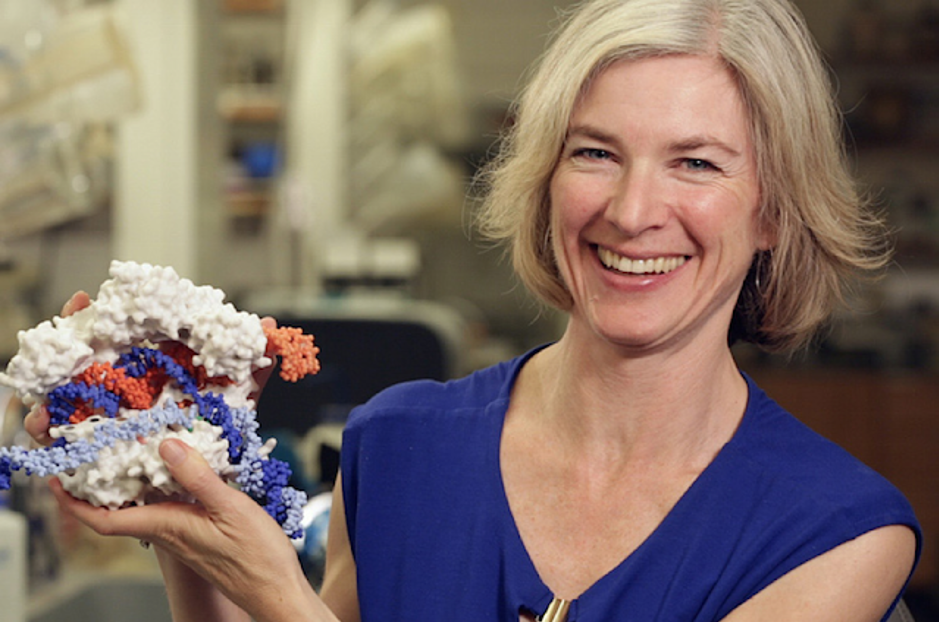 Dr Jennifer Doudna is one of the scientists who made the discovery that the Cas9 enzyme, found in Streptococcus bacteria, could act like molecular scissors to cut and edit DNA in cells.
A recent breakthrough genome editing technique, known as CRISPR/Cas9, will hopefully allow scientists cut out, replace, or add DNA sequences to the genome using an enzyme known as Cas9. Say you have a gene behaving badly that you want to stop; the Cas9 enzyme can be guided to this target gene in the human genome, whereby it can then cut both strands of DNA of the target gene. The host cell will attempt to repair this break in the DNA, but repair mechanisms in cells aren’t perfect and some of the genetic information will likely be lost. This resulting mutation could result in inactivation of the target gene, and could be very effective in cases whereby removal or ‘knock out’ of gene function is beneficial, for example mutation of the protein that HIV requires to infect white blood cells. Using the CRISPR system to repair a mutant disease gene and restore its normal function is a lot more complex and requires more work before it can be considered as a treatment. This new technology currently represents the most precise yet simplest and cheapest approach to genetic modification.
Benefit vs. Risk (or Cancer vs., um…Cancer)
In order for gene therapy to be successful, the delivered gene must be inserted into the correct target cells, in the correct location in the DNA, and must continue to work for the life of the patient. As with all therapies, there are risks when it comes to gene therapy if it is not able to achieve all these goals. Toxicity, inflammation (leading to organ failure in some cases) and cancer promotion are all serious risks. A notable example of gene therapy gone awry was seen in trials for SCID; initial results showed great promise for the treatment when a number of children were cured of the condition, however some later developed leukaemia, a cancer of white blood cells, as a result of the gene being inserted at the incorrect locus. Current gene therapy only targets the genetic defect in the patient given the treatment, but future gene therapy could include germline editing which ensures that the ‘fixed’ genes are passed on to offspring. As with any research that includes looking at the developing foetus, it is significantly restricted, and inserting new genes may have unforeseen effects on the developing foetus that could translate into long term health risks.
Harder, Better, Faster, Stronger
I think everyone can agree; gene therapy to treat and cure some of the world’s most prevelant and debilitating diseases is definitely a good thing. But many are concerned about the ethical, social, and moral implications of the ability to re-programme the human genome. What’s stopping us at disease genes? Who wouldn’t want to be smarter, more athletic, more talented without all the hard work it usually takes? Why not just get some gene therapy to achieve your goals? In addition, gene therapy isn’t going to be cheap, meaning that only the wealthy will have access to this pioneering treatment causing societal boundaries between the have and the have-nots to become even more pronounced. These considerations aren’t something to be looked at in the future, after all gene editing is already here with there are a number of gene therapies already currently in clinical trials. Aside from the proposed medical and healthcare advancements, the applications of genetic editing extend far beyond the human body; wheat can be made immune to killer fungi, whilst yeast can be engineered to consume plant matter and produce ethanol providing hope for a future without petrochemicals. Gene-editing will change the world as we know it.
– Jess
Learn more about gene editing:
Genetic Science Learning Center (University of Utah)
Genetics HomeReference: What is Gene Therapy? (US National Library of Medicine)

 Science, She Wrote
Leave a comment