Scopolamine, also known as hyoscine hydrobromide, or the more evocative ‘Devil’s Breath’ has been reported by various news outlets as a drug that ‘zombifies’ its victims, robbing them of free will. But how true are these claims? Well, given that they come from tabloid newspapers, I’m going to assume there is a high degree of sensationalism involved. Regardless, whilst scopolamine has gained a reputation in the criminal underworld of Colombia, this drug could hold promise as an effective pharmaceutical treatment for depression.
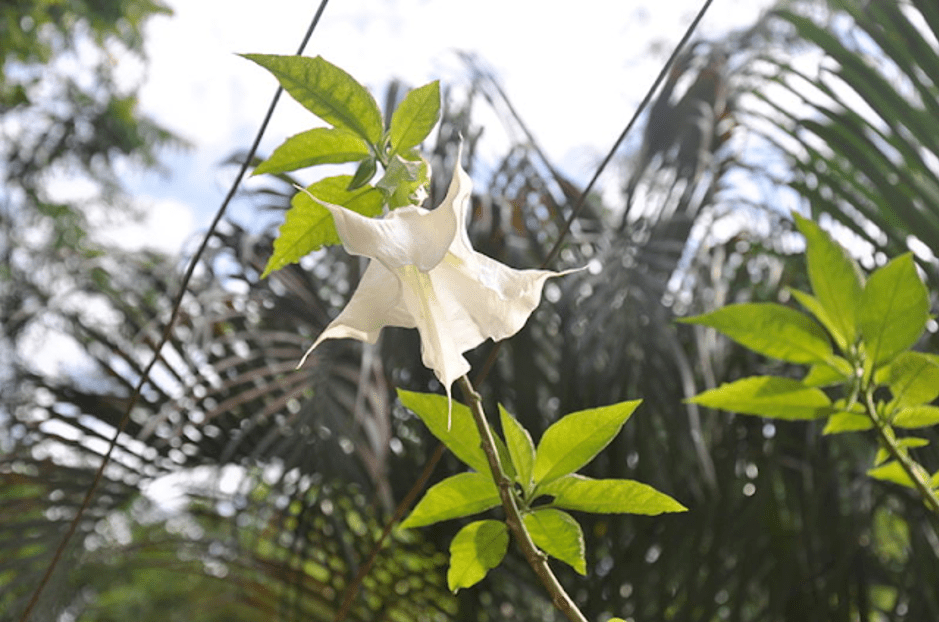
Quite a beautiful flower from which “Burundanga” (Scopolamine) is extracted (Jorge Láscar, Wikimedia)
The Most Dangerous Drug in the World(?)
Scopolamine is a naturally derived from Solanaceae, the nightshade family of plants, and is described by some tabloid newspapers as “the most dangerous drug in the world”, and in a 2012 Vice documentary as ‘World’s Scariest Drug’. (Vice’s attitude to documentary making appears to be a ‘Jack of all trades, Master of none’ approach, from important medical and healthcare issues such as the backstreet abortions of the Philippines to socially shocking and obscure traditions like the apparent rite-of-passage of bestiality encouraged in northern Colombia, to the inane coverage of Fashion Weeks around the world). Nevertheless, I’ll admit that it was this documentary that originally sparked my interest to research the drug further to discover whether it really deserves such notoriety.
A criminal connection and zombification
In some parts of the world, even the mere mention of scopolamine is enough to induce fear, and for good reason. Scopolamine, found in liquid or powder form, can be administered to an unsuspecting victim through food or beverages and acts to render its victim helpless to criminal acts. The United States Overseas Security Advisory puts ‘unofficial estimates’ of incidents involving scopolamine at around 50,000 in Colombia alone. It is suggested that a prevalent use of the drug is by young, attractive women targeting wealthy men, to rob them of rather large amounts of money or possessions. Scopolamine can also be employed as a ‘date-rape’ drug and several unconfirmed news items claim the drug has been used to coerce victims to even relieve themselves of an organ!
In reality, the dangerous nature of scopolamine comes from its ability to act on the brain, incapacitating the victim and impairing memory. It is unlikely that the drug actually removes free will, but like alcohol or other drugs it may limit your capacity to respond to dangerous situations allowing you to be taken advantage of. Smaller doses can cause feelings of sedation, disorientation, slurred speech, behavioral changes, confusion, fatigue, and even feelings of euphoria, however at higher doses it may serve as a hallucinogen and deliriant, causing extreme confusion and an inability to control actions. In even larger doses scopolamine can result in respiratory failure and death.
The dangerous nature of scopolamine is demonstrated by a case in which an off-duty officer became the victim of scopolamine whilst in a topless bar. Presumably slipped into his unattended beer, he suffered a myriad of symptoms including dizzyness, dry throat, and blurred vision before completely blacking out. Observers witnessed him staggering about, shouting incoherently, and waving his gun around, ultimately shooting someone at point blank range, inflicting serious injury. Despite no physical corroborating evidence (toxicological blood analysis or evidence of scopolamine at the topless bar) a jury acquitted the defendant of attempted murder after a psychiatric expert concluded that the defendant appeared to have suffered from scopolamine intoxication.
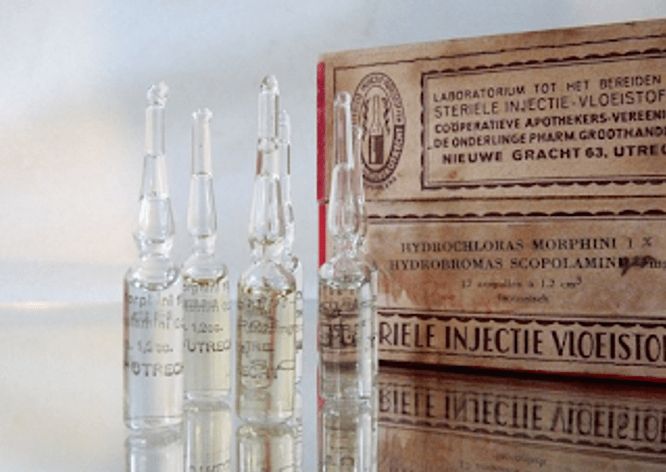
‘Twilight Sleep’ – A mixture of morphone and scopolamine administered to women during childbirth. Henk Albert de Klerk (Wikimedia)
Childbirth, truth serum, and a witch and her broomstick.
Research scopolamine further and you will find it has a colourful past. In order to ease the painful experience of childbirth, physicians in the early 1900s used a concoction known as ‘Twilight Sleep’ – a mixture of morphine as an analgesic (pain-killer) and scopolamine to induce amnesia (assumedly so that the mothers would not remember the horror of childbirth!).
After his experiences using twilight sleep on his patients Dr. Robert House, a Texas obstetrician, concluded that individuals under the spell of the drug possess no imagination, and therefore were unable to lie, leading him to introduce scopolamine as a ‘truth serum’ to interrogate suspects. In his publication in 1931 in The American Journal of Police Science he states:
“There are lawyers that maintain that my idea is not constitutional, whilst others affirm that if it is permissible for a state to take life, liberty, and property because of crime, it can be made legal to obtain information from a suspected criminal by use of a drug.”
Ultimately, early 20th century investigations into scopolamine as a ‘truth serum’ were dropped due to its numerous side effects. Despite this, unsubstantiated reports circulate the web about the use of scopolamine as truth serum used for interrogation by everyone from the CIA during the Cold War, to Nazi Germany, and Czechoslovak communist state security secret police as recent as 2009. The official line from the CIA is that evidence for the use of scopolamine can be found extensively by the police force and in Soviet-led murders.

Linda maestra! (Pretty teacher!) Plate 68 of Los Caprichos: two witches riding on broomstick over landscape (1799) by Francisco de Goya
Perhaps a more comical use of scopolamine is the suggestion that witches would smear their naked skin and handles of their broomsticks with potions made from mandrake plants (which contain scopolamine and atropine) and ‘ride’ the broomstick, allowing the hallucinogenic and euphoria-inducing concoction to be absorbed through their skin and mucous membranes of the vagina. Apparently this provided the sensation of floating, allowing witches to believe they were flying through the air on their broomstick.
Putting ‘evil’ to good use
It’s more than likely that quite a few of you reading this have, at some point, consumed scopolamine. The drug is on the World Health Organisations list of essential medicines, and many well-known brands use hyoscine hydrobromide as the active ingredient in travel sickness medications to reduce nausea and vomiting; it’s even taken by U.S. Space astronauts. More recently, research has suggested a rapid and effective antidepressant action of scopolamine when administered to patients with Major Depressive Disorder (MDD).
Classic antidepressants are classified as selective serotonin reuptake inhibitors (SSRIs) or serotonin-noradrenaline reuptake inhibitors (SNRIs), which are though to work by increasing levels of the chemical messenger molecule serotonin in the brain. Many may attest to the success of these drugs – I myself was once taking an SSRI in effort to deal with my own depression; my experience and thoughts on which are perhaps best saved for another post – however the apparent ‘success’ of these treatments does not necessarily prove serotonin deficiency as the root cause of depression. Furthermore, the use of SSRIs or SNRIs appears to fail in around 40% of individuals. Whilst the ‘chemical imbalance’ hypothesis of depression may dominate, at least in the minds of the general public and pharmaceutical companies, it is clear that the reality of this condition is likely to be much more complex, extending beyond chemical imbalances into physiological abnormalities of brain structure and contributing psychological factors.
Nevertheless, the ‘chemical imbalance’ hypothesis continues to be extensively researched and in recent years has taken on a new focus looking at the role of the acetylcholine system in the pathophysiology of depression. Acetylcholine is another chemical messenger and in this case it may be that unusually high, chronic levels of acetylcholine may cause depression. Antidepressant therapy to block the biological action of acetylcholine could be used to treat individuals unresponsive to serotonin-mediated treatments. Scopolamine is structurally similar to acetylcholine, which means it can interact with the same receptors targeted by acetylcholine, to block the action of acetylcholine. Whilst this research is still in its preliminary phase, and requires larger studies before results can be confirmed, it highlights the surprising nature of drugs to do both good and evil; the ‘World’s Scariest Drug’ could one day help millions of people.
– Jess [Last updated April 2020]

 Science, She Wrote
Leave a comment