Biohackers around the world are doing something amazing; they’re milking yeast! Driven by the desire to reduce the environmental impact and ethical implications of dairy farming (or because there really is no vegan cheese substitute that tastes as good as the real thing), scientists are going from farm pasture to petri dish in a bid to make milk, without the cow!
Got milk?
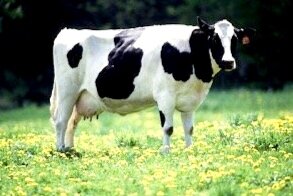 The humble dairy cow
Milk is pretty awesome; besides its liquid state, milk is used to make some of our favourite food products such as butter, cheese, yoghurt, and ice-cream. Though the health benefits of consuming milk are contested, worldwide production of milk is increasing year on year, reaching an estimated 843 million tons in 2018; this demand for milk means we need a lot of cows! So what’s the problem with more cows? Well, to put it bluntly, one huge issue is cow farts. Dairy cattle account fora whopping 65% of livestock carbon dioxide emissions. In addition to climate change contributions through greenhouse gas production, the expansion of agriculture raises huge concerns with regards to land degradation, water pollution, and biodiversity loss.
So what’s the solution? Should we all go vegan?
The sales of non-dairy milk alternatives such as almond, soy, and hazelnut milk have increased dramatically since 2004, totalling around $1.8billion in 2014 (that’s around £1.5 billion). With these milk alternatives becoming increasingly available in supermarkets, they represent a viable option for consumers wishing to switch from dairy milk; however when you consider the comparative cost per litre, cows milk comes in at over half the price cheaper than most non-dairy alternatives currently readily available on the market, and so is much more appealing to consumers, especially those on a budget.
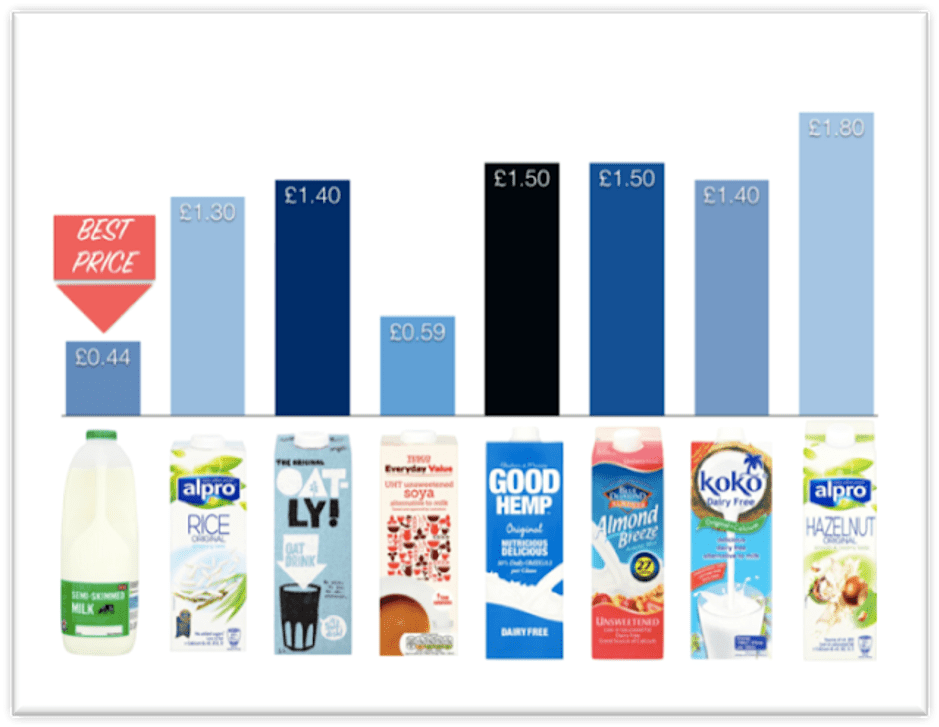
Comparative cost per litre of cow’s milk and milk alternatives. Prices from Tesco (2016)
Almond milk – bad for the planet?
Cost aside, there is controversy and confusion regarding production and consumption of non-dairy milk products. It takes 1.1 gallons (about 4 litres) of water to produce a single almond; with California farmers alone producing an approximate 2.1 billion pounds of almonds in 2014, that’s a lot of water. A 1 litre carton of almond milk is made using approximately 16 almonds, therefore its production requires at least 64 litres of water. Sounds awful right? Maybe not so when compared to dairy milk production which requires 1,020 litres of water per 1 litre of milk!
The dangers of Soya Milk: Myths and Misinformation
Soy products contain naturally occurring compounds called phytoestrogens which have a very similar chemical structure to oestrogen, a hormone found in the human body (see below). Because increased levels of oestrogen are linked to a slightly increased breast cancer risk, this understandably deterred consumers from trying soya milk as a dairy-alternative. The American Cancer Society explains that whilst some studies in rodents have found some association, these animals were given very high doses and are thought to process the phytoestrogens differently from humans. The Food Standards Agency and The UK Society of Dieticians list numerous benefits of eating soya foods including reducing heart disease, decreasing menopausal symptoms, improving bone health, and it may even help reduce the risk of cancer.
 Chemical structure of isoflavone (left), a phytoestrogen found in plants and oestrogen (right), 17-β-estradiol, found in humans.
Lab fresh milk: The science of cow-less milk
It appears that consumers are spoilt for choice when looking for a suitable alternative for dairy milk, whether it’s for pouring on cereal, making a cuppa, or baking a cake, but some may feel that there really is no good alternative that can fully replace dairy milk in either taste or use. So how are scientists stepping up to be farmers of the future and sort the issues surrounding milk production?
Researchers are working to identify the genes in cow DNA that code for the proteins found in cow’s milk. Once these genes are identified, the genes can be made in the lab and inserted into bakers yeast (yes, the same yeast you use to bake bread!) which then produce protein substances identical to those found in natural cows milk. Vegetable fats, minerals, and sugars can then be added to produce the final product and as no bacteria are present the shelf-life of synthetic milk should be much longer than traditional milk.
 © Indiegogo/RealVeganCheese
These modified yeast are genetically engineered (and so are considered to be genetically modified organisms, or GMOs), however no genetically modified yeast would be present in the final product. Just in case you were worrying the mutated yeast would somehow find there way out of the lab and wreak havoc on the world, rest assured the yeast possess genetic modifications meaning that life outside of the lab is impossible, and so there is no way for them to survive in the natural ecosystem.
Put it on your shopping list!
Cow-less milk and dairy products could be hitting our shelves sooner than you think; ‘Muufri’ hit the science news outlets in 2014 with prospects of cow-less milk being on our supermarket shelves as early as 2017. Whilst this has yet to appear, the company (now rebranded as Perfect Day) do appear to be manufacturing and selling animal-free frozen dairy dessert on their website. In addition, a San Francisco based team of biohackers and citizen scientists working on creating ‘Real Vegan Cheese’, although their website does not appear to have been updated in a while.
Whilst the benefits to making lab-harvested milk are numerous (reduced environmental impact, no animal welfare issues, agricultural sustainability, and production efficiency), we have to remember that dairy farming is big business and provides a significant source of employment; there are almost 50,000 farmers and farm workers relying on the dairy industry for income in the UK alone, and so any big changes to the consumer market with have serious impact on livelihood.
What do you think about animal-free dairy products? Would you consider them to be vegan? Let me know your thoughts in the comments below.
– Jess
Last updated May 2020

 Science, She Wrote
Leave a comment